Distribution
The distribution in ULTImodel is performed with distribution.DistributeTraffic.
Target values
Using the class TargetValues, the total travel volume is split into the four sectors
national long- and short distance and international OD and transit.
Input: country DataFrame with attributes for classification and totals.
import distribution.DistributeTraffic as DistributeTraffic

import pandas as pd

country_layer = pd.read_csv('country_layer.csv')
country_layer.head()

>>> output

    cntr_code   index   border_share    border_length   border_length_shared    border_crossings_count  neighbors   population      area            car_mio_pkm  freight_mio_tkm
1   DK          0       0.015467        4088.436575     63.236291               5.0                     2           8.396369e+06    43653.093630    60000        15000
2   FI          0       0.269796        8715.390137     2351.374349             136.0                   3           9.547163e+06    337512.028767   65000        17000
3   NO          0       0.101108        24434.055949    2470.468692             176.0                   3           8.527085e+06    322504.893423   65000        20000
5   SE          0       0.213012        9981.249404     2126.124196             128.0                   3           1.621385e+07    449736.409751   100000       50000
Initialize with TargetValues and the country_layer
tv = DistributeTraffic.TargetValues(country_layer)
Target values for personal transport in person kilometers traveled for DK
pt=tv.targets_personal_transport(cn='DK', target_col='car_mio_pkm')
pt

>>> output

{'short': 38917497147.80412,
 'long': 20929430184.74586,
 'int': 146360460.06437054,
 'trans': 6712207.385638687}
Target values for freight transport in vehicle kilometers traveled and trips for DK,
short-distance is further subdivided in sectors (LCV, MFT, HFT)
ft=tv.targets_freight_transport(cn='DK', target_col='freight_mio_tkm')

>>> output

{'lcv': 2400000000.0,
 'mft': 449999999.99999994,
 'hft': 273347783.1152192,
 'trips_short': 79150845.0484885,
 'long': 461086483.1505175,
 'trips_long': 3347303.631950553,
 'int': 416644412.4854073,
 'trips_int': 3024671.9565818245,
 'trans': 93921321.24885575,
 'trips_trans': 403289.59421090997}
Gravity model
Long-distance trips are distributed with GravityModel, producing an OD trip matrix.
Input: TAZ GeoDataFrame with attraction attributes, cost matrix np.array, target values
(see TargetValues)
import distribution.DistributeTraffic as DistributeTraffic

import geopandas as gpd
import numpy as np

taz = gpd.GeoDataFrame.from_file('DK-taz-atts.gpkg')

taz.head()

>>> output

    nuts_id     cntr_code   nuts_name           geometry                                            population      index_nat   index_int   id  length
0   DK011       DK          Byen København      MULTIPOLYGON (((12.50479 55.63734, 12.48025 55...   1.199214e+06    0.588597    0.676324    0   19.055466
1   DK012       DK          Københavns omegn    MULTIPOLYGON (((12.24627 55.70664, 12.25874 55...   8.048375e+05    0.749279    0.860955    1   111.140495
2   DK013       DK          Nordsjælland        MULTIPOLYGON (((12.24627 55.70664, 12.21994 55...   6.529701e+05    0.665808    0.765043    2   367.978524
3   DK014       DK          Bornholm            MULTIPOLYGON (((14.88943 55.22813, 14.94373 55...   4.738833e+04    0.091693    0.105359    3   59.449975
4   DK021       DK          Østsjælland         MULTIPOLYGON (((12.24627 55.70664, 12.16537 55...   3.613609e+05    0.392641    0.451162    4   134.617609

cost_mtx = np.load('cost-matrix.npy')
cost_mtx.shape # (origin, destination, cost), cost: 0=travel time, 1=distance

>>> (69, 69, 2)

pt = {'short': 38917497147.80412,
      'long': 20929430184.74586,
      'int': 146360460.06437054,
      'trans': 6712207.385638687}

ft = {'lcv': 2400000000.0,
     'mft': 449999999.99999994,
     'hft': 273347783.1152192,
     'trips_short': 79150845.0484885,
     'long': 461086483.1505175,
     'trips_long': 3347303.631950553,
     'int': 416644412.4854073,
     'trips_int': 3024671.9565818245,
     'trans': 93921321.24885575,
     'trips_trans': 403289.59421090997}
Initialize with GravityModel
gm = DistributeTraffic.GravityModel(cost_mtx, taz, taz_cn='cntr_code')
Personal transport trip matrix
trips_pt = gm.trip_distribution_pt(target=pt['long'], cn=cn, mob_rate=25, occ_rate=1.3)  # cars (personal transport)
trips_pt[:3, :3]

>>> output
Scaling factor personal transport for DK: 0.940780924347826
array([[       0.        , 12769235.98231415,  4371570.57699052],
       [14108225.57493652,        0.        ,  3533537.04995944],
       [ 3868113.92794895,  3632011.70280941,        0.        ]])
Freight transport trip matrix
trips_ft = gm.trip_distribution_ft(target_vkt=ft['long'], target_trips=ft['trips_long'], cn=cn)  # trucks (freight transport)
trips_ft[:3,:3]

>>> output
Freight transport gravity model result for DK: Relation to target vkm 0.7624308514138889
array([[    0.        , 30357.34659726, 25671.69472289],
       [30455.28146353,     0.        , 33256.92980559],
       [25480.89080153, 33418.32286164,     0.        ]])
Intrazonal trips
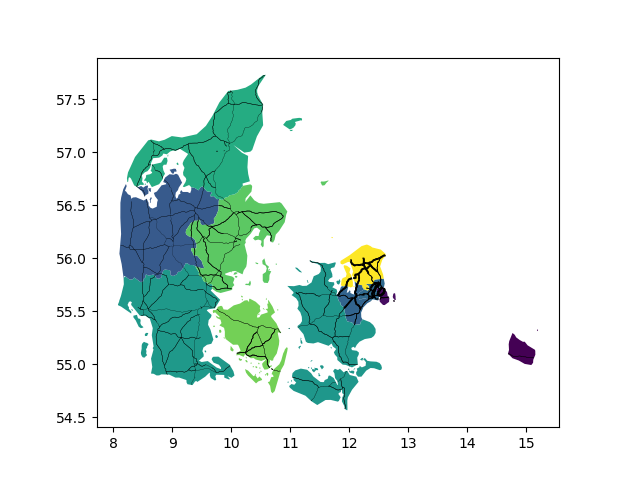
Short-distance trips are assigned to the road network within a cell (single) or within multiple cell within a pre-defined distance (multiple). The VKT are equally distributed using weights for road types.
Input: TAZ GeoDataFrame with attraction attributes, network edges GeoDataFrame, target values
(see TargetValues)
import distribution.DistributeTraffic as DistributeTraffic

import geopandas as gpd

taz = gpd.GeoDataFrame.from_file('DK-taz-atts.gpkg')

taz.head()

>>> output

    nuts_id     cntr_code   nuts_name           geometry                                            population      index_nat   index_int   id  length
0   DK011       DK          Byen København      MULTIPOLYGON (((12.50479 55.63734, 12.48025 55...   1.199214e+06    0.588597    0.676324    0   19.055466
1   DK012       DK          Københavns omegn    MULTIPOLYGON (((12.24627 55.70664, 12.25874 55...   8.048375e+05    0.749279    0.860955    1   111.140495
2   DK013       DK          Nordsjælland        MULTIPOLYGON (((12.24627 55.70664, 12.21994 55...   6.529701e+05    0.665808    0.765043    2   367.978524
3   DK014       DK          Bornholm            MULTIPOLYGON (((14.88943 55.22813, 14.94373 55...   4.738833e+04    0.091693    0.105359    3   59.449975
4   DK021       DK          Østsjælland         MULTIPOLYGON (((12.24627 55.70664, 12.16537 55...   3.613609e+05    0.392641    0.451162    4   134.617609

edges = gpd.GeoDataFrame.from_file('edges.gpkg')
edges.head()

>>> output

        highway     speed_kph   index   nuts_id     geometry                                            length      tt      ultimo_id   type
0   0   primary     63.0        NaN     DK032       LINESTRING (8.75547 55.16922, 8.75502 55.16959...   17.558210   1003.0  1           3
1   0   primary     63.0        NaN     DK032       LINESTRING (8.75547 55.16922, 8.75591 55.16884...   7.344446    420.0   2           3
2   0   primary     80.0        NaN     DK032       LINESTRING (8.75496 55.31883, 8.75514 55.32270...   2.645051    119.0   3           3
3   0   primary     63.0        NaN     DK032       LINESTRING (8.75496 55.31883, 8.75013 55.31339...   17.558210   1003.0  4           3
4   0   primary     63.0        NaN     DK032       LINESTRING (8.75496 55.31883, 8.76117 55.32033...   19.593661   1120.0  5           3

pt = {'car': 38917497147.80412}

ft = {'lcv': 2400000000.0,
     'mft': 449999999.99999994,
     'hft': 273347783.1152192,
     'trips_short': 79150845.0484885}
Initialize with IntraZonal
iz = DistributeTraffic.IntraZonal(taz, edges)
Assign VKT from target to network by determining VKT per TAZ and distributing said VKT on
all roads within the TAZ with road_type_weighted_single
net_r, taz_r = iz.road_type_weighted_single(target=pt, veh_types=['car'])

net_r[['ulitmo_id', 'nuts_id', 'car_short']].head()

>>> output

    ultimo_id   nuts_id     car_short
0   1           DK032       2.845761e+06
1   2           DK032       2.845761e+06
2   3           DK032       2.845761e+06
3   4           DK032       2.845761e+06
4   5           DK032       2.845761e+06

taz_r[['nuts_id', 'car_sub']].head()

>>> output

    nuts_id     car_sub
0   DK011       3.445021e+08
1   DK012       5.091953e+08
2   DK013       6.505540e+08
3   DK014       3.849412e+07
4   DK021       2.271284e+08
Assign VKT from target to network by determining VKT per TAZ and distributing said VKT on
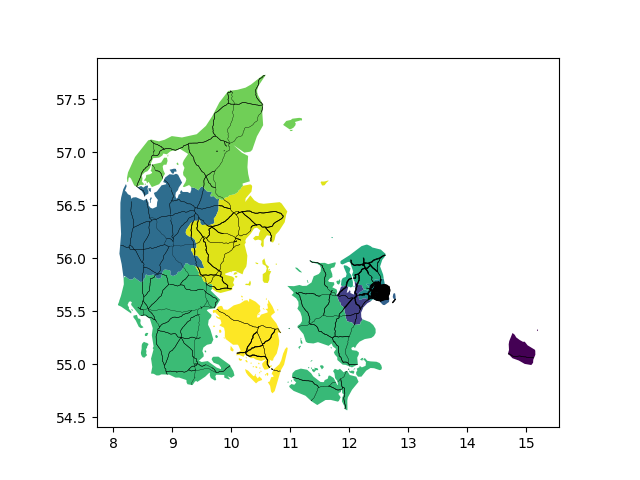
all roads within the TAZ and surrounding TAZ within a pre-defined distance with road_type_weighted_multiple.
It is possible to set a higher weight to the main TAZ during assignment.
The distance between TAZ is based on the distance matrix. Furthermore, the area of each TAZ in km² is calculated so that smaller TAZ are guaranteed to have their surroundings included.
# read distance matrix
distance_mtx = np.load('distance-matrix.npy')

# calculate area
iz.taz.to_crs(epsg=3035, inplace=True)
iz.taz['area'] = iz.taz.area  # area per TAZ (smaller TAZ always get surrounding TAZ included, independent from distance)
iz.taz.to_crs(epsg=4326, inplace=True)

# intrazonal assignment
net_r, taz_r = iz.road_type_weighted_multiple(target=pt, matrix_dis=distance_mtx, veh_types=['car'],
                                               weights = pd.DataFrame({'type': [0, 1, 2, 3], 'weight': [0.75, 1.5, 3.5, 3.5]}),
                                               index='population', fac_cell=1.5, distance=50000, occ_rate=1.3)
net_r[['ultimo_id', 'nuts_id', 'car_short']].head()

>>> output

    ultimo_id   nuts_id     car_short
0   1           DK032       2.189047e+06
1   2           DK032       2.189047e+06
2   3           DK032       2.189047e+06
3   4           DK032       2.189047e+06
4   5           DK032       2.189047e+06


taz_r.head()

>>> output

    car_sub         nuts_id
0   6.505052e+07    DK011
1   3.573749e+08    DK012
2   9.930296e+08    DK013
3   2.961086e+07    DK014
4   3.355154e+08    DK021